
7.28.2011


7.21.2011
Notions of Death
Recently, I have been giving a lot of thought to the topic of my pre-thesis investigation. Up to this point, I have been thinking primarily about impermanence and its connection with natural processes of decay, which I find beautiful. I feel American society has a genuine aversion to notions of human decay or death. While this seems obvious, I think American society has this fear to the nth degree. Could my thesis project be an opportunity to create an architecture that directly deals with American notions of death, while simultaneously addressing the issues of decay through the structures materiality? I have been thinking about this for the past couple weeks and am having trouble making a decision. My thesis research has left me without the traditional keystones most architecture students pre-thesis experiences, like for example, program and site, which at some point I will have to address. Could thinking about America's ingrained fear of death provide me an opportunity to demystify or rethink our paradigms on dying? To cast death in a new light? If so, would it be appropriate to start thinking about a program that would, in one way or another, tackle these notions?
My concern here, is that addressing the decay of materiality and human passing might fundamentally take on a powerful issue that has the potential to outshine the real roots of my thesis. Would a building that deals with human death become to human and therefore less architectural? I keep jumping the fence back and forth trying to decide. Ruminating on this.
7.13.2011
7.07.2011
Dissecting Suburbia_James Kunstler
Kunstler, while coming off somewhat cynical here, hits our misplaced notions of suburban success on the head. I hope to use the information contained in this talk and address it directly in the design and research associated with my thesis this coming final semester. I agree that our urban environments are going to have to perform at a much more efficient and holistic way than many of our urban cores do today.
6.12.2011
AMON TOBIN_Mutek
This is simply phenomenal work. Simultaneously: structural, technological, and musical.
4.07.2011
Methodology

Primodernal examines the inherent absurdity in proposing indigenous intervention within the urban context.
 Sensodernation addresses sensation in relation to an architecture associated with the rational. This juxtaposition of opposing or unaligned ideals brings a heightened clarity to the fundamental differences of each.
 3.25.2011
Zumthor
a) Does this illustrate that Zumthor doesn't use a concept but instead imagery?
"I think that every project has its theme. And it has to be formulated in a very strong way, so that the entire building and all things, can be explained by this principal theme. For me, the principal theme isn’t an abstract idea, but a physical one. The architecture which interests me is concrete architecture, not architecture as an abstraction. So there is already a body: the idea is a real body."
“I think the chance of finding beauty is higher if you don’t work on it directly,” Zumthor has said in describing his philosophy. “Beauty in architecture is driven by practicality. This is what you learn from studying the old townscapes of the Swiss farmers. If you do what you should, then at the end there is something, which you can’t explain maybe, but if you are lucky, it has to do with life.”
“I start with the collection, which is the basis of the museum. I think of separate collections, putting them on different floors, and then I have this terrible feeling, like I am in a department store, with shoes and shirts. So then I draw a forest. And in the forest I find jewels. I have to go here, there, to get them. I think of these jewels as parts of the collection, with their own pavilions, and this gives me a new feeling.”
Imagine the pavilions as metaphorical trees, he went on, “their volumes up in the branches, up in the air. So then I need a system of ramps. Maybe there is a catwalk system.” He sketched more quickly. “Now we have the opposite feeling from a department store. But I am getting confused, weak. I want the sense of informal freedom. I want to feel I am outside. I want a village, but with an upper level, a lower level.” He was sketching, sketching. “But it must give a feeling of peace. Now I feel it will be right only if the collections have real homes.”
Zumthor paused. “To say, ‘Let’s build something flexible,’ this doesn’t produce good results,” he said. “I have to give these alienated works of art some energy, something so that people don’t just pass by them and say, ‘Did you see African art?’ ‘I don’t know.’ So now I no longer see a village but a park. I hate a didactical museum. The goal is a highly emotional place, to put someone in a mood to listen or read or feel.”
“It’s about elevation,” he added. “Everybody can go up, after all.”
BOND
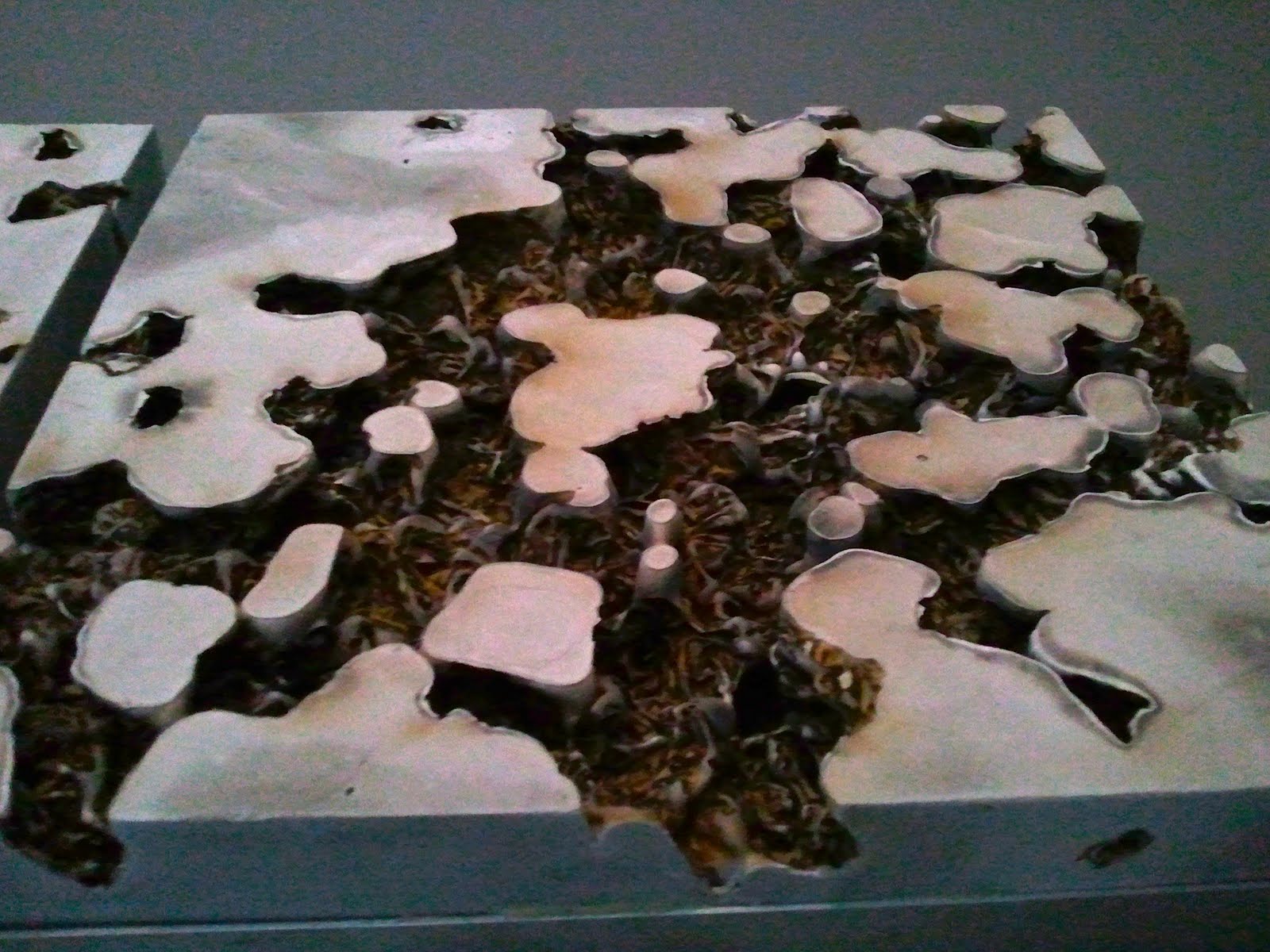
Our closest most human bonds are not forged easily. Fleeting glances and serendipidous encounters cannot shape the internal bedrock of our most guarded emotional memory. Only the strongest most beautiful human ties achieve such a rare feat. Our traditional employment of physica ltools and brute force for a task of this nature are of no facility. Patience, heart, and chance are some of thequalities required for a miracle such as this. And, only if individual patience remains sound and fate is allowed to reveal her true motivations may profound human bonds be born from tears of forgotten loss. The emotion thriving in embedded bonds born of patience become capable of more than simply marring stone. The strongest of these connections conjure a penetrating brilliant magnetism whose embodiment etches and vaporizes the most durable of nature’s geology. The relief buried in these stones, echo in memory of the phenomenal and beautiful power born from one relationship given two. Embedded those memories resonate.



Subscribe to:
Posts (Atom)